
Future Tech Workforce
Introduction
The intent of this mini and exploratory website or conceptual sandbox is to answer the following primary question:
“What skills and roles are emerging next?”
The time horizon is mid- and far-term of 5–15 yrs.
This mini website is intentionally conceptual, forward-looking, and systems-oriented, distinct from the more operational Industry STEM Pathways page.
This Future Tech Workforce page does not compete with Industry STEM Pathways.
It justifies it.
Pathways get people started.
Workforce foresight makes sure they arrive somewhere meaningful.
Purpose
Frame why pathways matter—what future roles are forming.
Core Focus Areas
-
Emerging technologies (Photonics, AI, GreenTech, Networks)
-
Skillset × Mindset evolution
-
Energy efficiency, optical networks, sensing
-
Workforce resilience and adaptability
-
Long-term regional competitiveness
This page is more conceptual and strategic.
✅ Cross-Links
How the mini websites between: ‘Industry STEM Pathways’ and the ‘Future Tech Workforce’ relate. l
Each minisite should clearly reference the other:
-
Industry STEM Pathways → “Explore where these pathways are heading”
-
Future Tech Workforce → “See how today’s learners enter these roles”
Think ladder + horizon, not duplication
The mini websites can be viewed in this way:
Pathways = Roads
Workforce = Destination Map
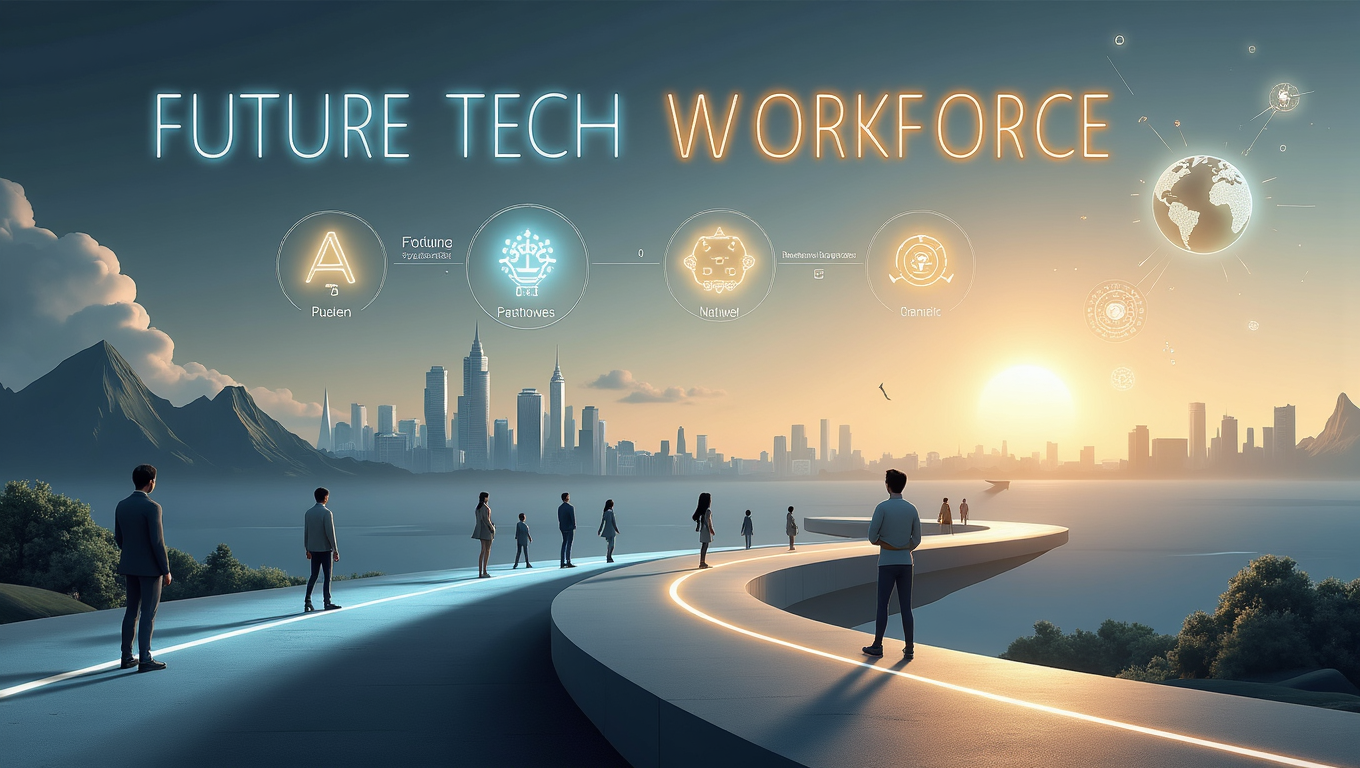
Frame why pathways matter by showing what future roles are forming.
Industry STEM pathways answer the question:
“How do people get started?”
The Future Tech Workforce page answers a different, strategic question:
“Why does getting started the right way matter—given what’s coming next?”
Technologies are converging, roles are hybridizing, and skill lifecycles are shortening.
This page exists to make visible where the destination is moving so regions, educators, industry, and learners can prepare intentionally rather than reactively.
In short:
Pathways without foresight risk training people for yesterday’s jobs.
1. Emerging Technologies
(Photonics, AI, GreenTech, Networks)
Future roles rarely sit inside a single discipline anymore. Increasingly, value is created at intersections:
-
Photonics underpins high-speed networks, sensing, autonomous systems, and energy efficiency
-
Artificial Intelligence augments decision-making across infrastructure, diagnostics, and operations
-
GreenTech integrates energy monitoring, optimization, and sustainability across systems
-
Advanced Networks connect everything—data, power, sensors, people
The workforce challenge is no longer “Do we teach the technology?”
It is “Do we prepare people to work across them?”
2. Skillset × Mindset Evolution
Technical skill alone is no longer sufficient. Neither is mindset alone.
Future-ready roles require:
-
Skillset: technical literacy, systems awareness, digital fluency
-
Mindset: curiosity, adaptability, ethical judgment, lifelong learning
The multiplication matters:
A strong skillset with a static mindset decays.
A strong mindset multiplies skill relevance over time.
This page focuses on how roles evolve, not just what skills exist today.
3. Energy Efficiency, Optical Networks, and Sensing
These themes reflect invisible infrastructure—systems people rely on but rarely see.
Examples:
-
Optical networks that move data with lower energy cost
-
Sensors that enable predictive maintenance and efficiency
-
AI-assisted control systems that optimize performance in real time
Future workforce readiness depends on understanding these foundational layers, not just visible applications.
This is where Photonics becomes strategic—not niche.
4. Workforce Resilience & Adaptability
Future careers will almost certainly include:
-
multiple role changes,
-
re-entry into learning,
-
transitions between technical and leadership responsibilities.
Workforce resilience means:
-
being able to re-climb the readiness ladder,
-
translating experience across domains,
-
adapting to tools that don’t yet exist.
The page emphasizes capability renewal, not static career ladders.
5. Long-Term Regional Competitiveness
Regions that thrive will:
-
anticipate workforce shifts early,
-
align education with emerging industry needs,
-
retain talent by offering visible growth pathways.
Those that don’t may:
-
train talent that leaves, or
-
struggle to attract next-generation industries.
This page frames workforce readiness as regional infrastructure, not just education policy.
Why This Page Is Conceptual & Strategic
Unlike the Industry STEM Pathways minisite, this page:
-
avoids tactical instructions,
-
focuses on trends and system behavior,
-
speaks to decision-makers and sponsors, not just learners.
It answers “Where should we be heading?”
pathways answer “How do we drive there?”
How the Two Minisites Cross-Link (Critical)
These pages should explicitly reference each other, creating coherence rather than duplication.
From Industry STEM Pathways → Future Tech Workforce
Prompt language:
“Explore where these pathways are heading.”
This invites readers to lift their gaze from steps to horizon.
From Future Tech Workforce → Industry STEM Pathways
Prompt language:
“See how today’s learners enter these future roles.”
This grounds strategy back into action.
Together they form a closed loop:
-
strategy informs pathways,
-
pathways feed future readiness.
✅ Visual Cue — Simple Mental Model
Internally (and optionally on the site), keep this framing:
Pathways = Roads
Workforce = Destination Map
-
Roads tell you how to move.
-
Maps tell you where you’re going.
You need both—or you risk moving efficiently in the wrong direction.

You said:
ChatGPT said:
You said:
ChatGPT said:
References
Here’s a concise summary of the program described at that link (Front Range Community College — FRCC, Optics & Laser Technology):
✅ What the Program Does
-
FRCC offers an Associate of Applied Science (AAS) degree and shorter certificate tracks in Optics & Laser / Optics Technology. frontrange.edu+1
-
The program trains students to become optics, photonics, or laser technicians — skilled in fabricating, assembling, and testing precision optical components. frontrange.edu+1
-
The curriculum covers key technical skills: reading optical engineering drawings, lean manufacturing, statistical process control, geometric dimensioning/tolerancing (for optics), thin-film coatings, fiber optics, quality assurance, manual fabrication, lab safety, and system-level work. frontrange.smartcatalogiq.com+1
-
Students complete a work-based internship and a capstone project, providing hands-on experience in real-world manufacturing or lab settings. frontrange.edu+1
Why It’s Significant
-
The program is the only optics/laser-technology program in Colorado, making it a unique statewide resource for training in optics and photonics. frontrange.edu
-
It serves a region (Northern Colorado / Boulder County) that is a national hub for optics and photonics — so graduates enter a high-demand job market with strong industry ties. The Future is Optics+1
-
The shorter certificate path (2 semesters) enables rapid entry — students or career-changers can retrain and enter optics manufacturing quickly. frontrange.smartcatalogiq.com+1
Typical Outcomes / Careers
Graduates are prepared for entry-level positions in optics fabrication and assembly, cleanroom or lab environments, laser and photonics manufacturing, and precision optics components manufacturing — in sectors such as imaging, measurement, telecommunications, medical devices, defense, aerospace, and semiconductor/quantum technology. frontrange.edu+2blog.frontrange.edu+2
✅ Why This Connects Well with Our Vision
Given your interest in integrating optics, photonics, AI, and GreenTech as part of a future-workforce framework:
-
FRCC’s program directly supplies technicians with foundational optics / photonics skills, aligning perfectly with your “Photonics as anchor technology” pillar.
-
The hands-on, production-oriented, industry-aligned training model mirrors the structure you envisage for realistic, repeatable STEM-to-Workforce pathways.
-
Colorado’s photonics hub status — and the fact that FRCC is unique statewide — means that this program offers a regional vantage point: scalable model, industry relevance, and a ready pool of talent for future GreenTech / photonics-centered initiatives.
2. Young Adult Program – Boulder County
What the Young Adult Program Is
-
Serves young people ages 16–24 living in Boulder County (or within St. Vrain Valley School District) who are seeking help establishing a career path or continuing their education. Boulder County
-
Targets especially those who may face obstacles such as being a parent, lacking a high-school diploma, coming out of foster care, having a criminal-justice history, homelessness, or a disability. Boulder County
✅ Services Offered
-
One-on-one career coaching — dedicated support from a “Career Support Specialist” to help identify career/education goals, build a plan, and provide ongoing guidance. Boulder County
-
Work-based learning opportunities — paid internships, apprenticeships, or on-the-job training to gain workplace skills, confidence, and professional connections. Boulder County
-
Post-secondary education support — assistance with college admissions, financial-aid applications, and connecting with educational or training programs. Boulder County
-
Life-skills support: help creating a personal budget, building a resume, learning job-search skills (e.g. job listing platforms, interview prep), and understanding career opportunities available locally. Boulder County
What Participants Gain
-
Clarified career direction or education plan tailored to personal circumstances
-
Work experience (paid or unpaid) and a better understanding of workplace dynamics
-
Improved job-search and application skills, resume support, and increased confidence
-
Pathways into stable employment or continued education with local industry awareness
Practical Notes on Eligibility & Process
-
Must be 16–24 years old, a county or eligible-district resident, U.S. citizen or work-eligible. Boulder County
-
Must indicate a desire to work or attend school, commit to a 12-month minimum program with regular engagement. Boulder County
-
Application requires basic documentation (ID, SSN, etc.); for those facing barriers, WfBC offers assistance filling out paperwork when needed. Boulder County+1
Why It Matters
-
Provides a structured and supportive bridge for young adults who may otherwise struggle to connect with education or employment due to socio-economic barriers.
-
Offers a “second-chance” pathway — accommodating nontraditional backgrounds (early school dropouts, foster care history, parenting, or justice-involved youth).
-
Aligns with workforce and community development by creating entry-level access to jobs and training, potentially feeding into regional STEM, technical, or skilled trades pipelines.
✅ Key Takeaways
-
Photonics is enabling advances across the renewable energy stack — from improved solar generation to smarter energy storage and grid management. Optica
-
Solar power generation: Use of photonics in photovoltaics — through high-efficiency multi-junction cells, wavelength-selective materials, and advanced optical sensors/filters — is boosting light absorption and conversion efficiency in PV systems. Optica
-
Energy storage & grid management: Photonics technologies (fiber-optic sensors, optical modules, laser diodes, optical transceivers) offer real-time monitoring and data transmission to optimize battery / storage behavior and smart-grid stability. Optica
-
Manufacturing & quality assurance: Photonics-based inspection and non-destructive testing tools — e.g. SWIR imaging, infrared thermography, laser-scanning microscopes — help detect micro-cracks or defects in solar cells, improving reliability and longevity of PV modules. Optica
-
Strategic value: As renewable energy demand grows, photonics emerges as a critical enabling technology across generation, storage, distribution, and grid reliability — making it central to the global green-energy transition. Optica
-
Future integration with AI/IoT: The article suggests further combining photonics with AI and IoT to improve system-level monitoring, predictive maintenance, and intelligent grid control, enhancing efficiency and stability. Optica
Why It Matters (for Our Framework)
-
Confirms that photonics is not niche — it’s foundational in renewable energy systems (power generation, storage, grid).
-
Supports your anchor-technology strategy: photonics aligns with GreenTech, energy systems, and future-workforce preparation.
-
Provides real-world evidence for Photonics + AI + energy + workforce integration — fits neatly into your Pathway Readiness Ladder and Future Tech Workforce vision.
Below is a concise, workforce-ready translation of the Optica article into concrete roles and skills, aligned with your Pathway Readiness Ladder (entry → applied → leadership).
Photonics + Renewable Energy: Emerging Job Roles & Skills
Entry / Technician-Level Roles (Application-Focused)
These align well with community college, certificate, and early-career pathways.
-
Photonics / Optics Technician (Energy Systems)
-
Assemble, test, and align optical components used in solar panels, sensors, and grid hardware
-
Skills: optics fundamentals, precision measurement, cleanroom practices
-
-
Solar PV Inspection & QA Technician
-
Use photonics-based tools (IR thermography, laser scanning, SWIR imaging) to detect defects
-
Skills: imaging systems, data interpretation, quality assurance
-
-
Fiber-Optic Grid Sensor Technician
-
Install and maintain fiber-optic sensing systems for real-time grid monitoring
-
Skills: fiber handling, sensing principles, field installation
-
Mid-Level / Applied Engineering Roles
These represent Application → early Leadership transitions.
-
Photonics Applications Engineer (Energy)
-
Integrate optical components into renewable energy and storage systems
-
Skills: system integration, optics + electronics, customer/application support
-
-
Smart Grid Systems Engineer
-
Design and manage photonics-enabled smart grid architectures
-
Skills: networking, sensors, data flow, systems engineering
-
-
Energy Systems Data / Monitoring Engineer
-
Combine photonics-based sensing with analytics to optimize grid performance
-
Skills: sensor data pipelines, signal processing, Python/MATLAB
-
Advanced / Leadership-Oriented Roles
These roles map directly to Leadership on the ladder.
-
AI-Assisted Energy Optimization Engineer
-
Use AI to interpret photonics sensor data for predictive maintenance and efficiency
-
Skills: AI/ML integration, photonics sensing, systems optimization
-
-
Renewable Energy Infrastructure Architect
-
Design end-to-end energy systems using photonics, AI, and networked sensors
-
Skills: systems-of-systems thinking, energy economics, scalability
-
-
Photonics Program or Technology Lead (GreenTech)
-
Guide photonics strategy across solar, storage, and smart-grid initiatives
-
Skills: technical leadership, cross-discipline coordination, mentoring
-
Cross-Cutting Skills (Critical for the Future Workforce)
Across all roles, the article reinforces demand for:
-
Photonics fundamentals (light–matter interaction, sensing, optics)
-
Energy efficiency mindset (loss reduction, optimization)
-
Systems thinking (generation ↔ storage ↔ grid)
-
AI-assisted decision-making (monitoring, prediction)
-
Ethical & resilient infrastructure design
Strategic Insight (Synthesized)
Photonics is evolving from a component skill into a workforce backbone for renewable energy and smart infrastructure.
Future energy jobs won’t just “use” photonics — they will be built on it.
This makes photonics an ideal anchor technology for:
-
your Industry STEM Pathways minisite, and
-
the Future Tech Workforce horizon framing.